Rotogran: A Canadian Manufacturer’s Call For Stability Amid Trade Uncertainty

“Talk, negotiate, hammer out a new deal, so that at least we can have stability,” says Rotogran President Mike Cyr.

Rotogran’s president, Mike Cyr. Photo © Rotogran
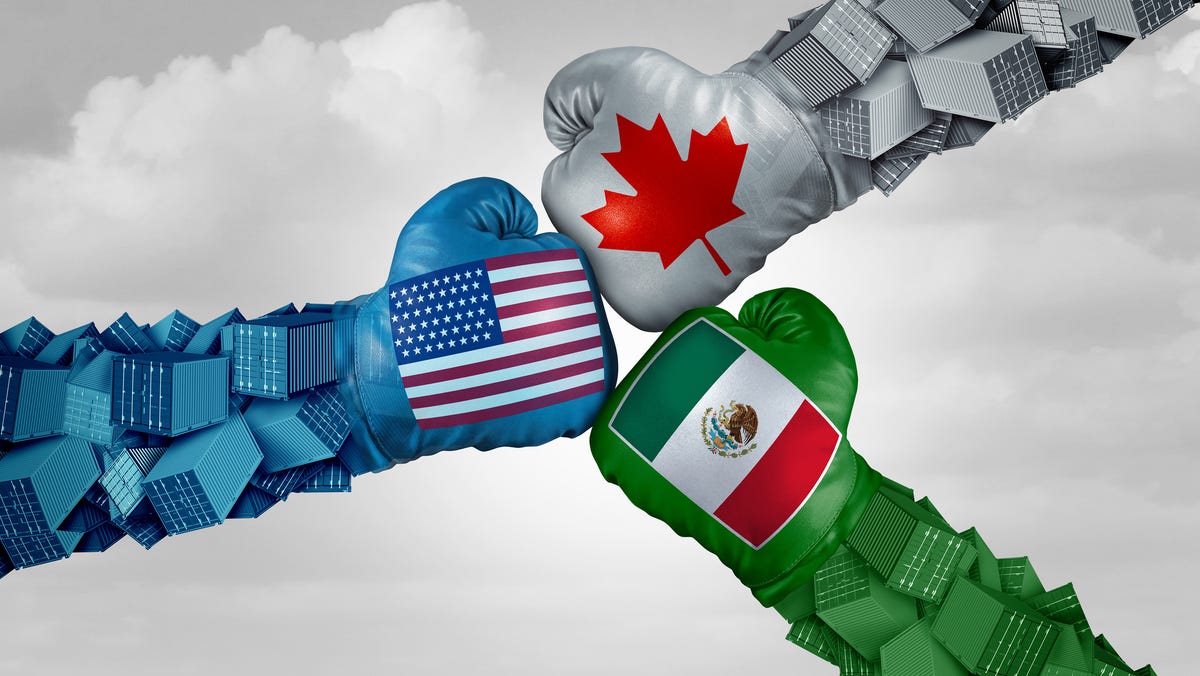
In the complex and often unpredictable landscape of international trade, Canadian manufacturers are finding themselves bracing against uncertainties emanating from the United States. For Rotogran International, an Ontario-based company that manufactures equipment used in plastic recycling, the ripple effects of U.S. tariff threats and trade policy shifts have become a matter of concern.
Mike Cyr, president of Rotogran, has experienced the changing trade landscape firsthand. His journey to ownership began on the shop floor as a machinist before rising through management ranks to become plant manager at the age of 22. In 1987, he began working with Rotogran in a sales capacity, eventually becoming the vice president of sales and later purchasing the company. “These hands know how to work. I can weld, machine and do it all, which puts me in a unique position to be able to understand what the customer wants and needs,” he said.

The outside of the Rotogran facility, which is based in Ontario. Photo © Rotogran
Rotogran builds machinery that grinds plastic waste—ranging from bottle caps to kayaks—into granulate for reuse in new plastic products. Unlike firms that import parts for assembly, Rotogran’s operations are largely in-house. “We are welding, machining, and painting. We make our own control panel and do everything right in our building,” Cyr said.
Their machinery is customised based on specific customer needs, especially designed to meet the continuous-use demands of the recycling industry. According to Cyr, the central philosophy of Rotogran is “looking after the customer and understanding the customer’s needs, and having empathy.”
The company’s business has historically been split between Canada and the U.S., with the U.S. accounting for over half of its sales in recent years. However, looming U.S. tariffs and fluctuating trade policy have led to new obstacles.
While the company has not been directly affected by tariffs on aluminium or automotive parts, the cost of electrical components sourced from the U.S. has gone up. These parts, often manufactured overseas but distributed through the U.S., are now subject to tariffs when brought into Canada. Rotogran is currently exploring alternative sourcing options from within Canada or directly overseas.
But the most disruptive impact has been the broader climate of uncertainty. “Trump’s tariff has not hit us directly financially, yet, not in the direct path, but his actions have largely affected us,” Cyr said. He describes a cautious atmosphere in the industry where both Canadian and American businesses are hesitant to invest. “Everyone’s on the fence, nothing’s going in the pipe anymore. People are too afraid to move, and because of that, sales are down,” he said.
The decline in business activity has led to concerns about the company’s backlog and potential layoffs. “We need stability. I can’t do long-term planning and forecasting while the tariffs are on and off again and again.”
Logistical challenges have compounded the issue. Cross-border shipping has become increasingly difficult due to added bureaucracy. Cyr describes border delays where shipments are set aside for inspection, demanding detailed documentation on component origins. “It causes a delay in our delivery and equipment just sits in U.S. warehouses,” he said. Cyr further pointed out that transport costs have also risen unpredictably, especially around tariff announcement deadlines.
In response, Cyr has intensified focus on the domestic market. A national marketing campaign is underway to engage Canadian manufacturers and public institutions. The company sold an equipment to the Government of Alberta, which initially imposed regulatory hurdles but ultimately decided to purchase the equipment. He highlighted it as an example of how Canadian institutions could prioritize local manufacturing in future procurement decisions.
Rotogran remains committed to Canadian-based manufacturing. For Cyr, maintaining production in-house supports quality, customisation, and control. “I’ve always believed in keeping the manufacturing here in Canada, and I’m going to continue to do that because that’s how come we’ve become successful. Being here gives us control of our manufacturing and allows us to customize the equipment to suit our clients,” he said. Cyr also cited the company’s reputation as a 100 per cent Canadian manufacturer as a valuable asset in terms of its growth.
If U.S. tariffs stay, Cyr said he may be forced to raise prices for American buyers and consider layoffs as a last resort. “If tariffs are implemented, I hope it is for all countries and not just Canada and Mexico. If tariffs are applied to everyone, then at least there’s a level playing field,” he said. Otherwise, the company may have to absorb part of the cost or lean on distributors to share the burden. He also sees potential in currency fluctuations: a weaker Canadian dollar could make his equipment more attractive to U.S. buyers.
Looking for new ways to remain resilient, Rotogran may reintroduce a strategy: buying back used equipment, refurbishing it, and reselling it with a warranty. “I think a customer would prefer to buy a refurbished North American-built product with a warranty, refurbished directly from the original manufacturer, as opposed to buying an inexpensive knockoff coming from overseas,” he said.

Rotogran employee on work workshop floor. Photo © Rotogran
Cyr is clear that his top priority remains protecting his workforce. The company employs 25 to 30 people, and he is determined to shield them from the worst of economic turbulence. “My responsibility is to keep my employees employed so that they continue having a living,” he said. “I’ll take the pain and hold on to employees as much as I can.”
While government incentives or programs may eventually provide relief, Cyr argues that long-term solutions lie in strengthening domestic resilience. He calls for better energy infrastructure, addressing internal trade barriers, and reducing reliance on unstable international markets. “Canada has to become more self-reliant,” he said.
Above all, Cyr hopes for a return to a stable trade relationship. He is critical of Canadian counter-tariffs, which he believes harm domestic manufacturers and consumers more than they hurt the U.S.
“Talk, negotiate, hammer out a new deal, so that at least we can have stability,” he said.
link