Funding for training, easier access to EI; federal minister touts tariff relief programs in Windsor
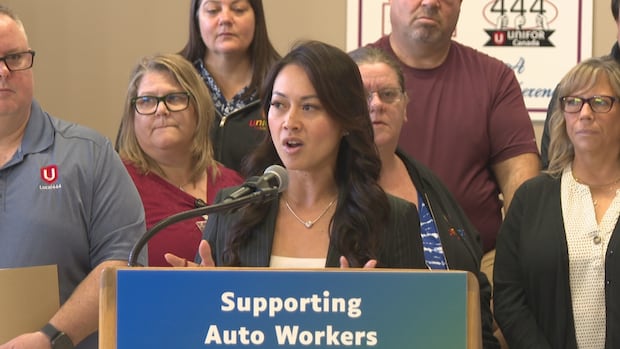
Canada’s Secretary of State for Small Business and Tourism was in Windsor Friday to promote new government programs to support local workers and members of the auto industry as U.S. tariffs continue to drive economic uncertainty.
Speaking at the Unifor Local 444 main hall, Rechie Valdez touted Ottawa’s announcement earlier this month that long-tenured employees will have access to 20 extra weeks of employment insurance (EI) starting Oct. 12 and retroactive to June 15.
The government has also waived the one-week waiting period for EI and changed separation payment rules so that severance payments don’t hold up EI, she said.
In addition, workers will have access to training through a mixture of employer-based training, short courses and career counselling, according to a government news release issued Friday in tandem with Valdez’s visit.
“You will also be able to get financial assistance while you are getting trained, so you don’t have to worry about … what you do from paycheque to paycheque,” Valdez told people assembled in the hall.
“This is about supporting workers to move into roles that are open now or that are coming next.”
End to tariffs would be more ‘important’
Funding for the training comes from a new $450 million reskilling package to train 50,000 workers, the release said.
The announcement follows a meeting of the Liberal government’s Ontario caucus in Windsor during the summer, during which MPs visited local workplaces such as auto and agricultural plants, she said.
The president of Unifor Local 444 called the announcement important but said it’s not the most important announcement.
“The most important announcement will be when they announce zero tariffs on auto parts and auto,” James Stewart said.

“We have an economy, especially in auto, that we’re so intertwined that the first goal always has to be zero tariffs.”
Unifor Local 200 President John D’Agnolo echoed Stewart’s words saying he’s scared to death of tariffs.
“We can’t have any tariffs,” he said. “Because the impact would be like no other. We have thousands and thousands of workers who rely on this auto industry.”
But D’Agnolo also thanked the government for its initiatives and said it’s important to celebrate them.
“In this community, we have the highest unemployment,” he said.
“And we need these incentives to protect people in our community.”
In addition to introducing its suite of programs to support workers through the tariff-related instability, the government has also announced new funding for businesses impacted by the uncertainty.
New funding for businesses
There’s more funding for its Regional Tariff Response Initiative is to help small and medium-sized businesses cut costs, improve supply chains and reach new markets, the release said.
It’s also making larger loans available through the Business Development Bank of Canada.
For larger businesses, it’s also providing more flexible financing and creating a fund to help companies diversify and reach new markets.
“I’ve met with some businesses, and a lot of them are challenged with, like, ‘How do we compete with the U.S.?'” Valdez said.
“This fund here is really intended … for plants to retool, actually invest so that they can keep their workers here as opposed to moving to the US. They can upgrade; they can invest; they can modernize their operations.”
link